Professional Laboratory
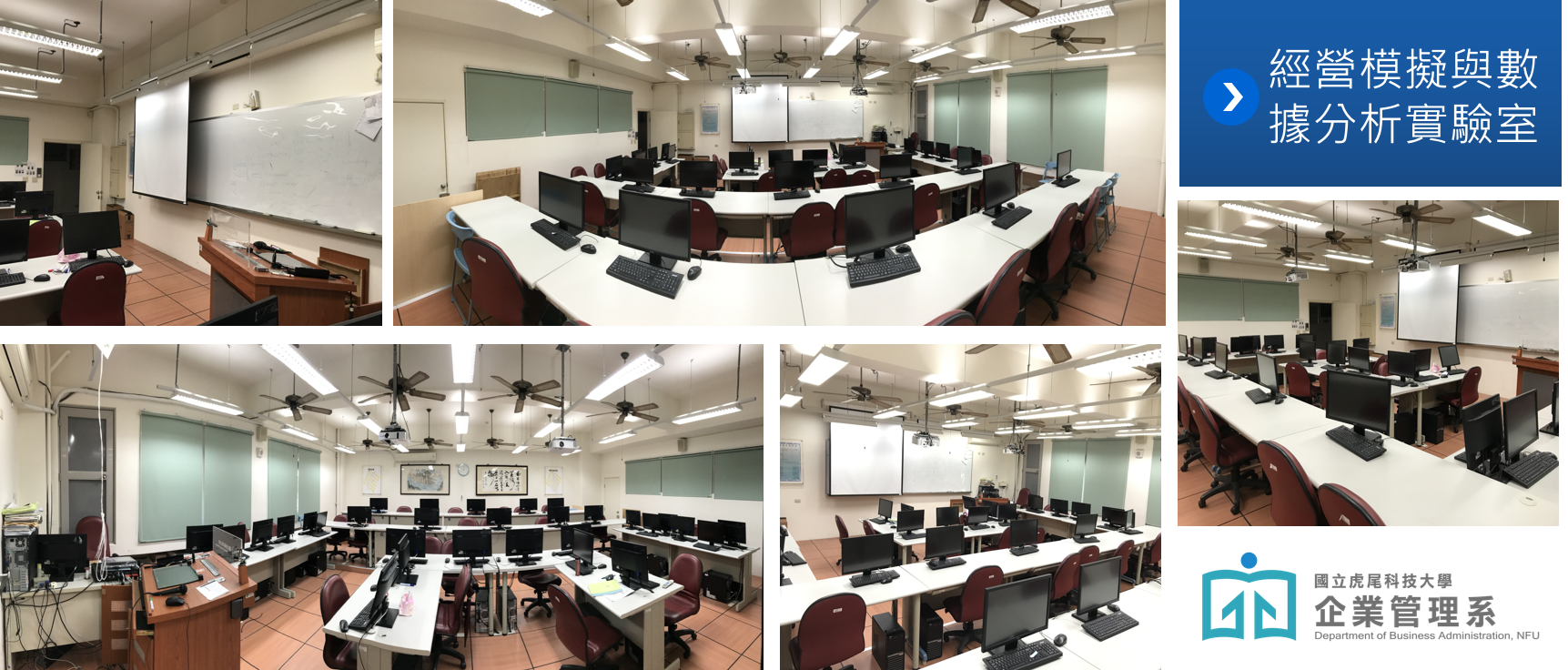
The Lab of Business Simulation and Data Analysis |
|
|
Location: |
Applied Arts, Sciences and Management Building 2F - Room CMA0206 |
|
Features: |
Trains students to integrate internal and external business information, formulate business strategies, and combine functional-level, business-level, and corporate-level strategies into a comprehensive system, enabling enterprises to gain competitive advantages, superior profitability, and future profit growth. |
|
Teaching Objectives: |
Develop capabilities in business simulation analysis, case study analysis, data analysis, and support for master’s/doctoral theses and undergraduate project work. |
|
Functions: |
Trains students to integrate internal and external business information, formulate strategies, and combine functional-level, business-level, and corporate-level strategies into a complete system, allowing enterprises to achieve competitive advantages, high profitability, and future growth. The lab uses the Business Game (also called Management Game), a teaching method widely used in MBA programs at major U.S. universities. Through system-based simulations of various business scenarios, students enhance their decision-making, environmental and competitive analysis, and problem-solving skills. Students practice analyzing business problems, setting parameters, and allocating resources. The MBS Business Intelligence Dashboard simulation system offers interactive and simulated teaching, helping students understand overall business operations in a fun and practical way, while learning about competitive business processes. The system covers production, sales, procurement, R&D, finance, and other functions, suitable for students with diverse expertise, cultivating a holistic view of business management. This simulation encourages “deep learning” rather than mere memorization. Another key feature is enhancing students’ data analysis skills. The lab emphasizes making decisions based on scientific data, strengthening students’ ability to analyze statistical information, from research question formulation, hypothesis development, data collection, data analysis, to drawing conclusions and providing recommendations. The lab has supported hundreds of theses and projects. |
|
Related Courses: |
Business Case Analysis, Strategic Management, Global Marketing, Marketing Management, Marketing Research, Business Data Analysis, Market Analysis and Forecasting, Research Methods in Business, Market Survey, Statistical Data Analysis, Project Work. |
|
Equipment: |
31 computers, servers, teaching broadcast system, amplifiers, whiteboard, 2 air conditioners, CATI telephone survey software, SPSS, whole-brain learning classroom podium, Statistica 10.0, Statistica data mining software, Statistica experimental design, LISREL 8.8, Minitab, R statistical software for training students in data analysis. MBS Business Intelligence Dashboard simulation system and MW Marketing Winner simulation system train students in planning and executing dynamic business strategies. |
 |
|
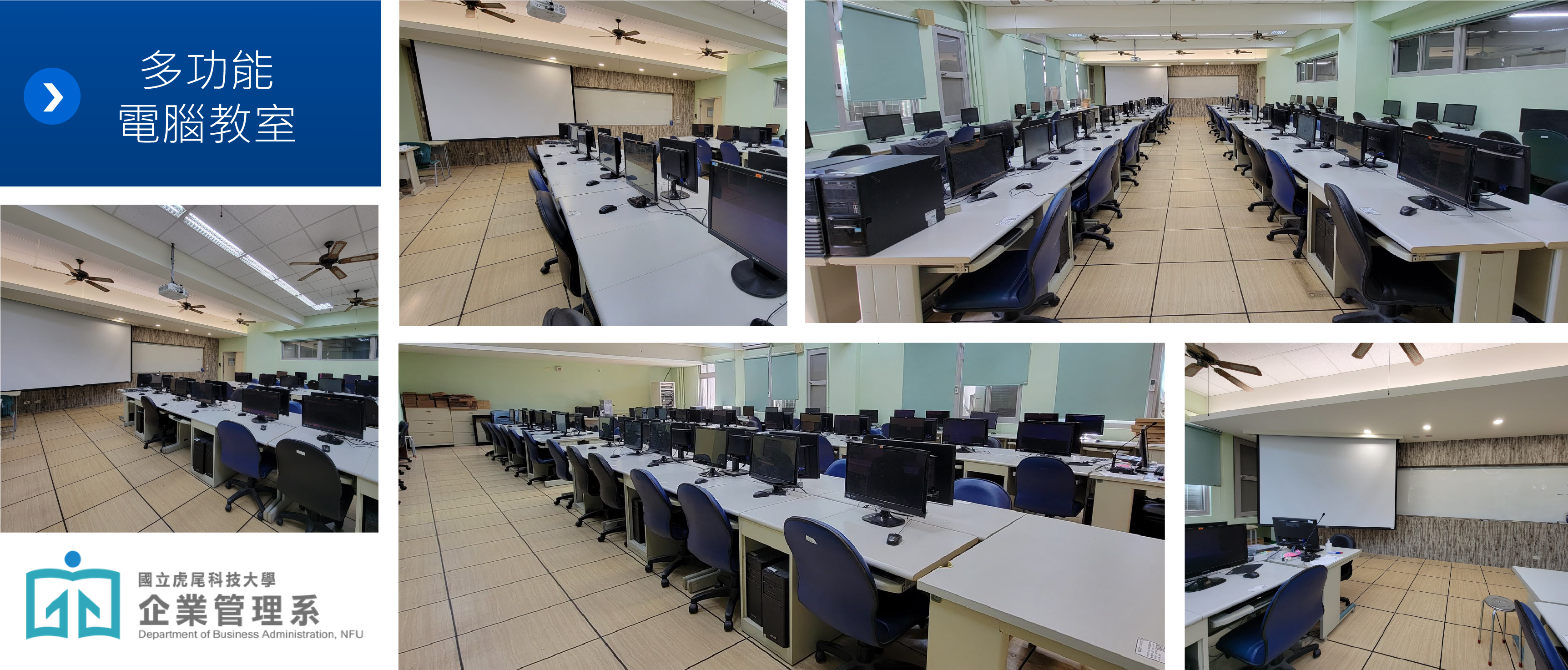
Multifunctional Computer Classroom |
|
|
Location: |
Applied Arts, Sciences and Management Building 2F - Room CMA0207 |
|
Features: |
Provides a teaching environment for business digitalization and business research methods, equipped with computers and analysis tools for relevant instruction. |
|
Teaching Objectives: |
Develop students’ skills in information processing and analysis across multiple areas. |
|
Functions: |
(1) Familiarize students with computer hardware and software. (2) Cultivate students’ skills in information processing and analysis. (3) Conduct training courses and certification exams commissioned by external organizations. |
|
Related Courses: |
Business Research Methods, Internet Marketing, Service Science, Enterprise Resource Planning, Information Management, Business Evaluation, Business Data Analysis, Business Intelligence, Management Information Systems, E-commerce, Supply Chain Management. |
|
Equipment: |
73 computers, 2 servers, teaching broadcast system, amplifiers, whiteboard, projector, 3 air conditioners, SPSS, SPSS Clementine, SPSS Amos, Economic News Database (updated annually). |
 |
|
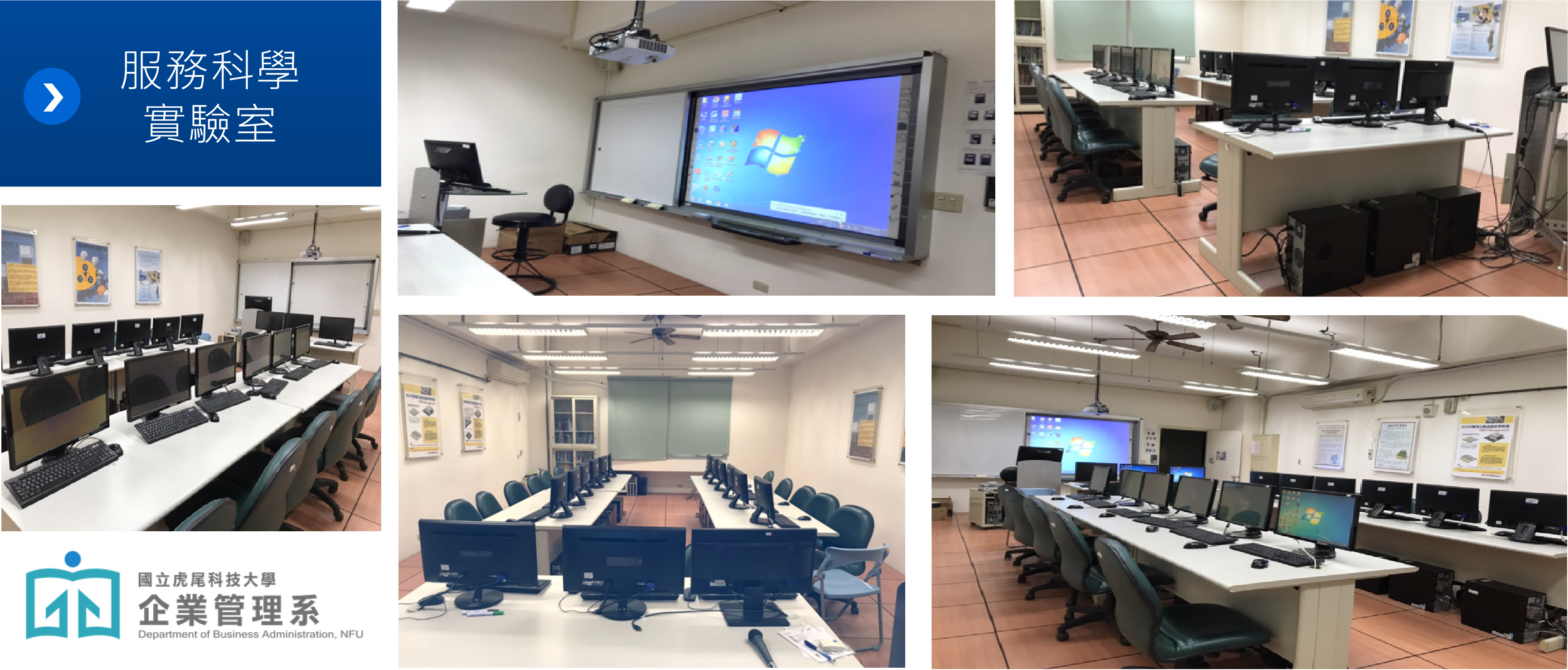
Service Science Lab |
|
|
Location: |
Applied Arts, Sciences and Management Building 2F - Room CMA0208 |
|
Features: |
Explores various topics in service science from a service industry perspective, such as IT applications in service management, service design, service site design (Enterprise Simulation), in-depth business data analysis (Data Mining), queuing theory, market research analysis, and sustainability strategies. It further develops solutions to address potential issues in these areas. Lab website: http://balabs.nfu.edu.tw/servicescience/ |
|
Teaching Objectives: |
This lab aims to establish an integrated IT application platform, including all necessary experimental equipment, to help students understand management technologies and the impact of technological development on the service industry. In business simulation training, service design and site design are explored using business simulation competition software, allowing students to analyze resource allocation in production, marketing, HR, R&D, and finance. Students develop market sensitivity, decision-making, and strategic planning skills. In data analysis, students practice data mining and warehousing techniques to extract actionable insights. Queuing behavior is studied through system simulation software. Market research training involves survey design and statistical analysis to understand consumer needs and market trends. Sustainability is included to teach students how businesses balance economic performance with environmental responsibility, fostering long-term competitiveness. |
|
Functions: |
(1) Explore applications in the service industry. (2) Conduct group-based business simulation discussions. (3) Integrate management techniques with technology. (4) Analyze and utilize business data extensively. (5) Conduct commissioned research and analysis. |
|
Related Courses: |
Research Methods, Business Data Analysis, Service Management, Internet Marketing, Strategic Management, Introduction to Business Intelligence. |
|
Equipment: |
16 computers, servers, teaching broadcast system, amplifiers, electronic whiteboard, air conditioning, FlexSim software, BOSS software, IBM® SPSS® Statistics 21 |
 |
|
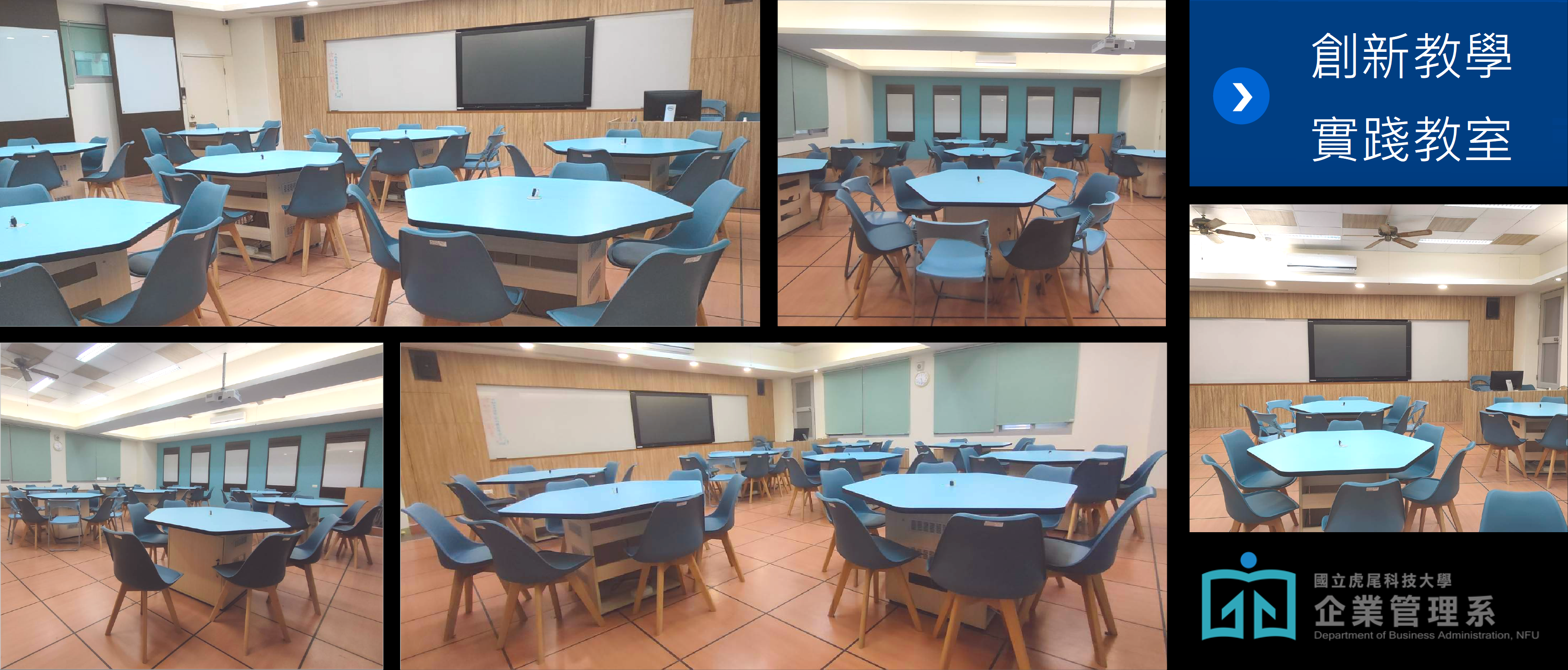
Innovative Teaching Practice Classroom |
|
|
Location: |
Applied Arts, Sciences and Management Building 2F - Room CMA0209 |
|
Features: |
Equipped with digital teaching tools to support interactive learning, compatible with traditional teaching formats and flipped classroom concepts. Emphasizes a student-centered teaching approach and builds a digitally enhanced smart teaching environment. |
|
Teaching Objectives: |
Establish a high-quality online learning environment and utilize digital teaching tools. The smart classroom provides digital assisted teaching functions, interactive teaching functions, and group collaborative learning functions to enhance students’ attention and learning efficiency. |
|
Functions: |
(1) Provide a platform for remote teaching to improve distance learning effectiveness. (2) Implement flipped classroom, student-centered learning model. (3) Enhance the effectiveness of Problem-Based Learning (PBL). (4) Facilitate real-time interactive teaching to strengthen teacher-student and student-student interactions. (5) Cultivate students’ teamwork and communication skills. |
|
Related Courses: |
Entrepreneurship Management, Marketing Management, Introduction to Business, Motivation and Leadership, Human Resource Management, Corporate Financial Management, Internet Marketing, Strategic Management, Technology Management, Behavioral Finance. |
|
Equipment: |
86-inch interactive LCD screen ×1, touch-control computer ×1, iPad ×1, projector ×1, group discussion teaching equipment, amplifier, glass whiteboard, 2 air conditioners, financial analysis software. |
 |
|
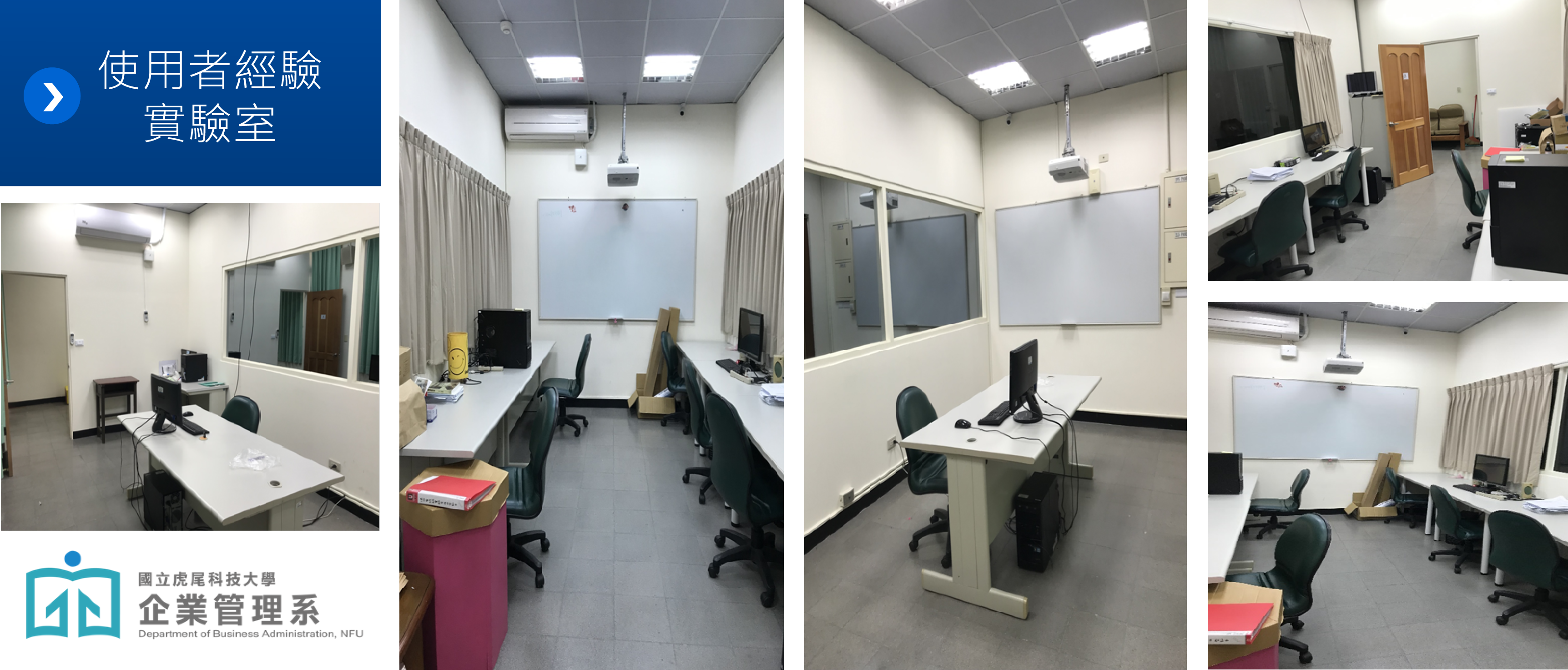
User Experience Lab |
|
|
Location: |
Art and Humanity Building 2F - Room CHB0204 |
|
Features: |
User Experience (UX) refers to an individual’s behavior, attitudes, and emotional responses when interacting with a product, system, or service. It encompasses personal perceptions, including cognition, emotions, preferences, and reactions. Conceptually, UX research goes beyond collecting usage data and surveys; it involves labs designed for methods such as expert evaluation, focus group interviews, and user testing. This lab uses physiological signals—brain waves, eye movements, facial expressions, heart rate, blood pressure, skin conductance—to understand user responses during business interactions. It supports cross-disciplinary research in business, management, and engineering fields. |
|
Teaching Objectives: |
Enable students to understand real user responses to products or services, interpret these responses, and explore their business implications. Students also operate VR devices, EEG, and eye-tracking equipment, using statistical and data mining tools to investigate user experience topics through technology-driven methods. |
|
Functions: |
(1) Develop user experience experimental procedures. (2) Train students to become business experiment specialists, capable of operating precision instruments and applying them in experiments. (3) Serve as a UX experimental facility for local businesses in central Taiwan. |
|
Related Courses: |
Management Information Systems, Data Mining, Business Data Analysis, Information Management. |
|
Equipment: |
12 desktops and laptops (6 high-end desktops with dedicated graphics cards), 3 projectors, observation one-way mirror, high-performance servers, VR devices, VR recording devices, dehumidifier cabinet, eye tracker, single-channel EEG, 32-channel EEG, head-mounted cameras, soundproof walls, desks and chairs, various tools, electronic whiteboard, 2 air conditioners. |
 |
|
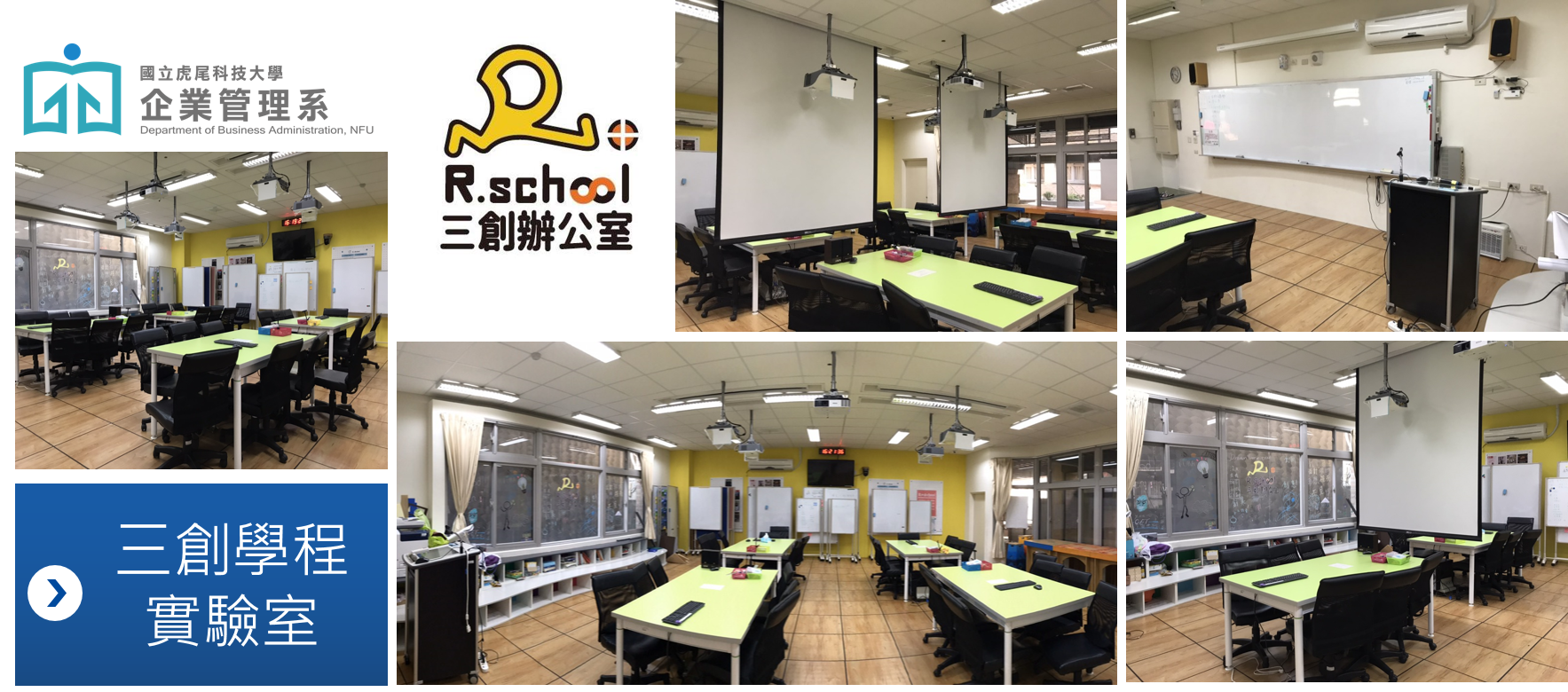
Tri-Innovation Program Lab |
|
|
Location: |
Applied Arts, Sciences and Management Building B1F - Room CMAB108 |
|
Features: |
Provides a dedicated space for student teams to carry out innovation and entrepreneurship activities. Through the process of implementing innovative and entrepreneurial ideas in small groups, students cultivate teamwork, innovative thinking, and entrepreneurial spirit. |
|
Teaching Objectives: |
Through activities such as generating innovative entrepreneurial ideas, confirming customer needs, creating prototypes, modifying and refining them, presenting and defending entrepreneurial concepts, writing business plans, seeking stakeholder engagement and support, and participating in Demo Day, students develop the entrepreneurial spirit of opportunity creation, risk-taking, learning from failure, and resilience. |
|
Functions: |
(1) Develop students’ abilities to manage the entrepreneurial process, from idea generation, customer needs survey, market size and industry analysis, opportunity evaluation, entrepreneurial development, business plan preparation, to fundraising. (2) Encourage students to adopt a more proactive mindset, willing to take risks and face failure with confidence. (3) Cultivate team collaboration, division of labor, and leadership skills. (4) Train students to clearly present innovative and entrepreneurial concepts to stakeholders in a short time. |
|
Related Courses: |
Creative Design Thinking, Entrepreneurship Management, Tri-Innovation Program, Innovation and Entrepreneurship Dream Program. |
|
Equipment: |
5 computers, 5 projectors with screens, 2 air conditioners, double-sided partition screens for discussion, desks and chairs. |
|
|
|